
This first week we introduce the concept of sustainability and its origin, motivation and roots. You can find the materials for this part in the block “The concept of Sustainability” below.
On the other side we have a closer look to indicators for characterizing sustainability and their use as part of global efforts to standardize the sustainability reporting for institutions (including the University of Oldenburg! 😉 and companies (GRI).
I: The concept of sustainability
This video gives you a basic understanding of the concept of sustainability, its roots and origins and main sources shaping it. Here are the slides.
Additional sources on special aspects raised during our sustainability definition:
- Historical emissions and current mitigation efforts: As-sya’bani, J.A.; Abbas, M.Z.; Alshaeki, A.; Torio, H. Assessing Global Responsibility: Comparative Analysis of Fairness in Energy Transition Between Developing and Developed Countries https://doi.org/10.3390/su17167470
I.1: Sustainability Indicators – GRI: the Global Reporting Initiative
The first video contains and introduction to indicators for sustainability assessment: what are they, how are they defined, who is defining them and how are they related to sustainability assessment. Slides
A second video gives you a good glimpse on the standards from the Global Reporting Initiative, which is one of the most internationally recognized addresses for sustainability reporting. Slides
II: Sufficiency
Here come the slides for the live pitch on sufficiency.
Additional sources on sufficiency:
There is not much literature or data available on the role of sufficiency yet. But some recent studies began analysing it and taking a closer look to its potential. Here you have some references to them. Recently this field has got greater attention, as its potential is indeed great. For years it was difficult to quantify its real importance, as not much research was done on that field. But this last paper (October 2024) () shows clearly the numbers and role of this strategy.
Wiese et al. 2024. The key role of sufficiency for low demandbased carbon neutrality and energy security across Europe. In: Nature Communications. https://doi.org/10.1038/s41467-024-53393-0
Wiese, F., Thema, J. & Cordroch, L. Strategies for climate neutrality. Lessons from a meta-analysis of German energy scenarios. Renew. Sustain. Energy Transit. 2, 100015 (2022). https://doi.org/10.1016/j.rset.2021.100015
Zell-Ziegler, C. et al. Enough? The role of sufficiency in European energy and climate plans. Energy Policy 157, 112483 (2021). https://doi.org/10.1016/j.enpol.2021.112483
EnSu. 2024. ENSU – THE ROLE OF ENERGY SUFFICIENCY IN ENERGY TRANSITION AND SOCIETY.
Lange et al. 2023. Citizens call for sufficiency and regulation — A comparison of European citizen assemblies and National Energy and Climate Plans. Energy Research & Social Science, Volume 104, October 2023, 103254. https://doi.org/10.1016/j.erss.2023.103254
Oeko-Institut 2023. Striking a Balance – The Role of Sufficiency in the Energy Transition. Last accesssed: 08.03.2024
IFEU. 2024. Sufficiency. Institute for Energy and Environment, Heidelberg. Last accesssed: 08.03.2024.
III: Our workshop
We will hold a workshop on the concept of sustainability and the role of technology, economic growth and social justice for influencing it. For this, please have a look at the following references:
References:
- Our common future, UN Report, 1987 – Chapters 2 and 3 of the report, give good hints on the role of the three mentioned issues above (technology, economy and social justice) for shaping the discourse and available options
- Soergel et al. 2021. A sustainable development pathway for climate action within the UN 2030 Agenda. Nature Climate Change | VOL 11 656 | August 2021 | 656–664 https://doi.org/10.1038/s41558-021-01098-3
This journal article discusses the impact and possible measures and policies to achieve a sustainable development on a global scale. - Here comes a somewhat placative paper on social-justice in the sustainability debate: Millionaire spending incompatible with 1.5 °C ambitions – ScienceDirect, DOI: https://doi.org/10.1016/j.clpl.2022.100027
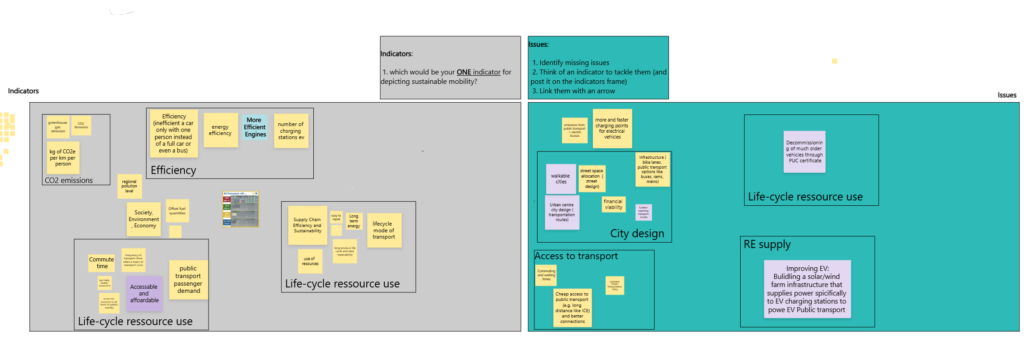
Your first view on indicators and issues for sustainable mobility is here
Workshop Results
Here you see your ideas on the importance of technology development, economy and social justice in the implementation of sustainability
…
This was the first picture on your voting of the “Quote Battle”
….
And the second version of that voting:
….