This week we deal with
i) the status of the mobility sector in Germany
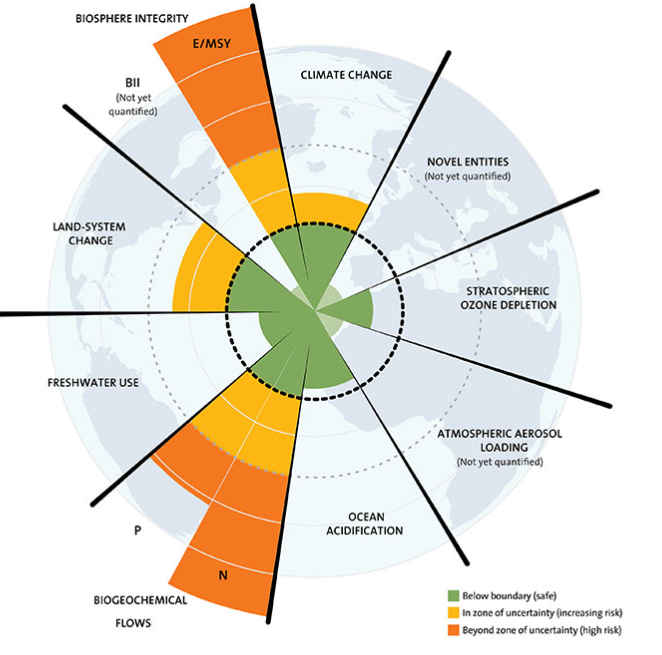
ii) the conceptof planetary boundaries
iii) as optional additional ideas and material you find some hints from contemporary changes and innovative concepts in the mobility sector on the example of Germany (for this see the video on the section “mobility trends and innovative concepts below)
I. Mobility trends and innovative concepts
We will have a live presentation introducing main indicators for charaterizing the state of mobility sector and its transition status. Here are the slides.
Additional information on this field, deepening that in the slides (a) or complementing it (b) are here:
a. This video gives you an idea of the current status of the mobility sector in Germany and its evolution in the past years. It gives special attention to emerging innovative mobility concepts intending to foster a transformation in the sector. Related slides.
b. This video presents a brief introduction to innovative/integrated mobility concepts. Related slides.
Mobility as a Service:
Here you can find the newest papers defining an upcoming framework for promoting/analysing mobility as a service, as one frame for sufficiency in mobility.
- Literature Review of Mobility as a Service. Sustainability 2022, 14(14), 8962; https://doi.org/10.3390/su14148962
- Mobility as what? https://doi.org/10.1186/s12544-024-00697-3
II. Planetary boundaries
2. Planetary boundaries: for this topic we will have a live lecture on the seminar room. And here come the slides
- W. Steffen et al., Planetary boundaries: Guiding human development on a changing planet. Science 347, 1259855 (2015). DOI: 10.1126/science.1259855
- Powering sustainable development within planetary boundaries – PubMed (nih.gov), Algunaibet IM, Pozo C, Galán-Martín Á, Huijbregts MAJ, Mac Dowell N, Guillén-Gosálbez G. Powering sustainable development within planetary boundaries. Energy Environ Sci. 2019 Jun 1;12(6):1890-1900. doi: 10.1039/c8ee03423k. Epub 2019 Jan 24. PMID: 31303892; PMCID: PMC6592157.
Additional literature
REPORTS on the status of transport and its transition globally, including data and indicators:
- Global Mobility report, 2022. https://www.sum4all.org/data/files/global_mobility_report_2022_04052023_final.pdf
- SloCAT 2023. SLOCAT Transport, Climate and Sustainability Global Status Report. 3rd Edition. https://tcc-gsr.com/wp-content/uploads/2023/09/SLOCAT-Transport-Climate-and-Sustainability-Global-Status-Report-%E2%80%93-3rd-Edition.pdf
Additional intresting sources on current innovative mobility concepts being discussed on local contexts:
- Really nice and inspiring movie (unfortunately only in French and German and French) with inspiring concepts for reducing the urban mobility: Wie gelingt die Verkehrswende? – Metropolen in Bewegung – Die ganze Doku | ARTE
- TED Talk from Carlos Moreno (the initiator of the 15 minute city): Carlos Moreno: The 15-minute city | TED Talk
- For those who prefer it read, here goes a paper from Nature on the 15 minute city: The ‘15-Minute City’ concept can shape a net-zero urban future | Humanities and Social Sciences Communications (nature.com)
Additional resources and answers
Here you can see the statistic for the bill.person kilometer (for personal transport, without goods transport) by different transport modes. As you see, there is a decrease due to covid, forllowd by a steep recovery to catch up and stay with the shy increasing trend as prior to the pandemic.
And here you can see the modal split for those kilometers in percentage, including as well human powered vehicles (or legs :-))

And here you can download and read the updated report from the SLoCAT “SLOCAT Transport, Climate and Sustainability Global Status Report- 2023”. On page 24 you find the reduced “barrels per day” that are estimated for different measures, as discussed in the class. That values in the picture are related to a study on “advanced economies” countries, so do not include worldwide potential. To put those figures into perspective the current global oil consumption (2022) was 97.3 million barrels per day (see Global oil consumption 2022 | Statista)